
Date: November 29, 2015
Season: end of Spring, and dry season
Our long, long dry season just keeps rolling on and our region here in north Queensland has now been declared a 'drought affected area'. Townsville has officially had two failed wet seasons - in both 2014 and 2015 - which means the conditions during the two dry seasons that followed have been significantly intensified. We're now going through one of our driest periods on record. Unfortunately, 86% our our entire state of Queensland is now drought declared.
The watering restrictions imposed by our City Council have been tightened for a second time this year, with Level 2 restrictions now in place. Our city's dam level is now apparently just below 30% capacity, and if it falls even further to 20% we will have Level 3 watering restrictions imposed.
 |
| Sprinkler time |
Level 2 restrictions means that we can now only have our sprinklers on twice a week on our allocated days, and only in the evenings between 6.00 pm and 8.00 pm. Odd numbered houses can put out sprinklers on a Wednesday and a Sunday for two hours in the evening, whilst even numbered houses can do this on a Tuesday and a Saturday. Any infringement results in a hefty fine. Hand-held watering is still allowed at this point in time though.

Of course, living in the 'dry tropics' as we do, we have been through periods like this before ... and in fact, we've been through much worse. We're now waiting to see whether or not the coming summertime is going to be as dry as predicted. Our summertime is the time when our wet season is supposed to arrive, but it's such a hit-and-miss affair and doesn't always turn up. If we have yet another failed wet season at the beginning of 2016, then the situation will require further restrictive measures.

There have been a few rather nasty bushfires that have flared up around Townsville in the last month or so. Winter/Spring are amongst the driest months of the year for us, and that's our bushfire season as well. In our particular corner of Townsville the fire danger rating is now at 'very high'. Just a couple of weeks ago there was an enormous bushfire raging through an area not far from our suburb, across the highway. Houses were lost and properties extensively damaged as a result. Thankfully, we haven't had any fires close by here.

The closest bushfire we've seen here in our neighbourhood so far, is the one that's been burning across the foothills of the ranges over the last three days.

The fire is well away from us, across the creek and burning through uninhabited bushland off in the distance, but we can see the smoke from our verandah.
At the moment, my garden is still doing fairly well. About two weeks ago, our little outlying suburb of Townsville received a wonderful short-lived downpour of rain, whilst the rest of the city and suburbs received a sprinkle. The reverse is usually the case. About 70 ml fell in a few hours here at Alligator Crrek. It was so unexpected and absolutely delightul. Of course, it didn't really do all that much given the length of the dry conditions we've endured so far, but the plants did seem a lot cheerier for a while, and there has been a faint hint of green out in the front yard.
 |
| Shot taken just last week |
This lovely hint of green won't last much longer as our daytime highs are now well and truly settled around the 32 deg C mark, with relative humidity levels rising to the 60% mark. Our summertime weather has arrived and any green grass cover will die off pretty quickly in the heat and humidity.
 |
| Murraya paniculata |
It was amazing though how that short, sharp downpour caused all the Murraya paniculata shrubs around here to suddenly burst into bloom a few days later.
 |
| Murraya paniculata flowers |
The perfume in the air was intoxicating as I took my early morning or early evening walks around the place. Yes, I know the Murraya is classified as an environmental weed and it does pop up quite regularly in various spots. I have removed most of them since we moved in here over 14 years ago, but I have also left just a couple here and there so I can enjoy the beautiful perfume from these gorgeous white flowers.
 |
| Gardenia |
Another shrub throwing out beautiful perfumed flowers right now is the Gardenia shrub that grows in the front-of-house garden bed. That was a well-established garden bed when we moved in, but the Gardenia has rarely bloomed over the years.
Granted, that poor Gardenia shrub is in an impoverished spot that rarely receives attention from me apart from the occasional watering, so I am part of the problem! Anyway, for some inexplicable reason that shrub has suddenly thrown out several blooms in the last couple of weeks.

 |
| Gardenia |
It's been wonderful experiencing the Gardenia perfume wafting in through the lounge room doors of a late afternoon when I arrive home from work and throw open the doors at the front of the house. The house is quite hot inside when I get home, and to have a lovely perfume steal inside when I open up to try and catch a breeze certainly gladdens the spirit. It's also such fun watching the flowers turn from stark white to a creamy gold colour.
There have been a couple of things happening around our place lately that have had the potential to bring down our spirits. As some readers would know from my last garden journal post, wallabies had ravaged and voraciously munched their way through so many plants through the winter and early spring that our place was looking decidedly ugly, compounded by the fact that we've had such a dry year.
Well, then we discovered that the two sets of wooden stairs - at the side and the front of our house - had rotted almost completely through in parts. Originally my husband thought he would just have to rip out a few of the treads and some of the railings, but the problem was much worse. Neither sets of stairs could be deemed safe any more, so they have to be demolished and re-built.
 |
| Demolition in progress |
This of course means another massive job that my darling husband had to undertake, with its accompanying mess. He's never built a set of wooden stairs before. He never trained to be a carpenter or had any huge woodworking experience, but he's always prepared to give anything a go.

He's been making such great progress on the side stairs. They're starting to look like stairs once more.
Unfortunately, with the side and front stairs out of action, I only have one way down to the laundry which is underneath the house. I have to walk out through the courtyard and go down the cement driveway that winds downhill to the workshop and laundry that both sit underneath one side of our house. Now that's usually a fairly easy thing to do ... until now.

Yes folks, that's the way into the laundry! Usually the cement driveway is clear and not covered by piles of leaves. However, we've had a pair of scrub turkeys build their nest in the raised garden bed at the back of the courtyard. You can see the raised garden bed off to the right in the photo above.
The male scrub turkey scratched up every single leaf in that garden bed first in order to form a mound for the nest. But he didn't stop there! For some unknown reason, the male has been scratching up loads and loads and loads of leaves from a section of the yard downhill from the driveway. Off to the left of the above photo, the land dips down to a little gully-like section, and the male has literally spent days and days scratching leaves uphill from there onto the cement driveway, and then spent hours scratching them up to the rock wall that surrounds the raised garden bed!


There are calf-deep piles in some spots next to the garden bed! I mistakenly cleared off the first huge carpet of leaves over a week ago, but the male wasn't impressed with that and came back to do a bigger, better job! It makes for a fun excursion to the laundry every day!
Another little hiccup that's happened around here is the demise of our oldest and largest Poinciana tree at the front of the property.


U - huh! That's what we came home to just last week. The Poinciana had toppled over out of the ground and was only really being held up by branches on the other Poinciana saplings in our neighbour's yard.

We think the problem was a fungi that we had noticed growing around the base of the tree earlier in the year around April. Ganoderma? Obviously it wasn't a good-guy fungi. We now know it's a wood-decaying fungi.

It certainly did a good job in just a few months. It seems to have gobbled up pretty much all of the inside of the base of the tree and its root system.

Anyway, now my poor darling husband has another massive job on his hands. He's already begun the chopping down phase, but his little chainsaw can only do so much. I don't think he's quite worked out how to get that massive stump out of the way. It's going to be a big enough job just getting rid of all the branches that have been cut down so far.
Well ... this is post has been a long, long tale of woe hasn't it!!!! I think it's time to move on to some brighter notes from the garden.
Let's see what's blooming despite the recent wallaby ravaging, and the horrid summertime temps., and the ever-so-dry weather we've had this year.

 |
| Delonix regia, or Poinciana |
First of all, the other Delonix regias, or Poincianas, are all in bloom. They're always a cheerful sight towards the end of a long, dry season. Those brilliant splashes of red and orange really do brighten up the dreary landscape.

I love looking out for the lone flower in the spray with the white speckled petal.

 |
| Lagerstroemia speciosa or Queen's Myrtle |
One of my Lagerstroemia speciosa, or Queen's Myrtle, has begun blooming and showing off its pretty purple flowers.
 |
| Tabebuia pallida or Pink Trumpet Tree |
Whilst the tall Tabebuia pallidas have been covered in its pale pink flowers for several weeks now,

providing delicious nectar for the Sunbirds.


My Plumeria rubra and Plumeria obtusa have been in bloom for weeks and weeks as well,
 |
| Planchonia careya, or Cocky Apple |


It's lovely walking around the place and noticing the fallen blooms scattered here and there. Nature's art work.
 |
| Mussaenda philippica 'Bangkok Rose' |
The Mussaenda philippica 'Bangkok Rose' is showing off its bracts and yellow flowers and providing some much needed colour out in the front garden bed.
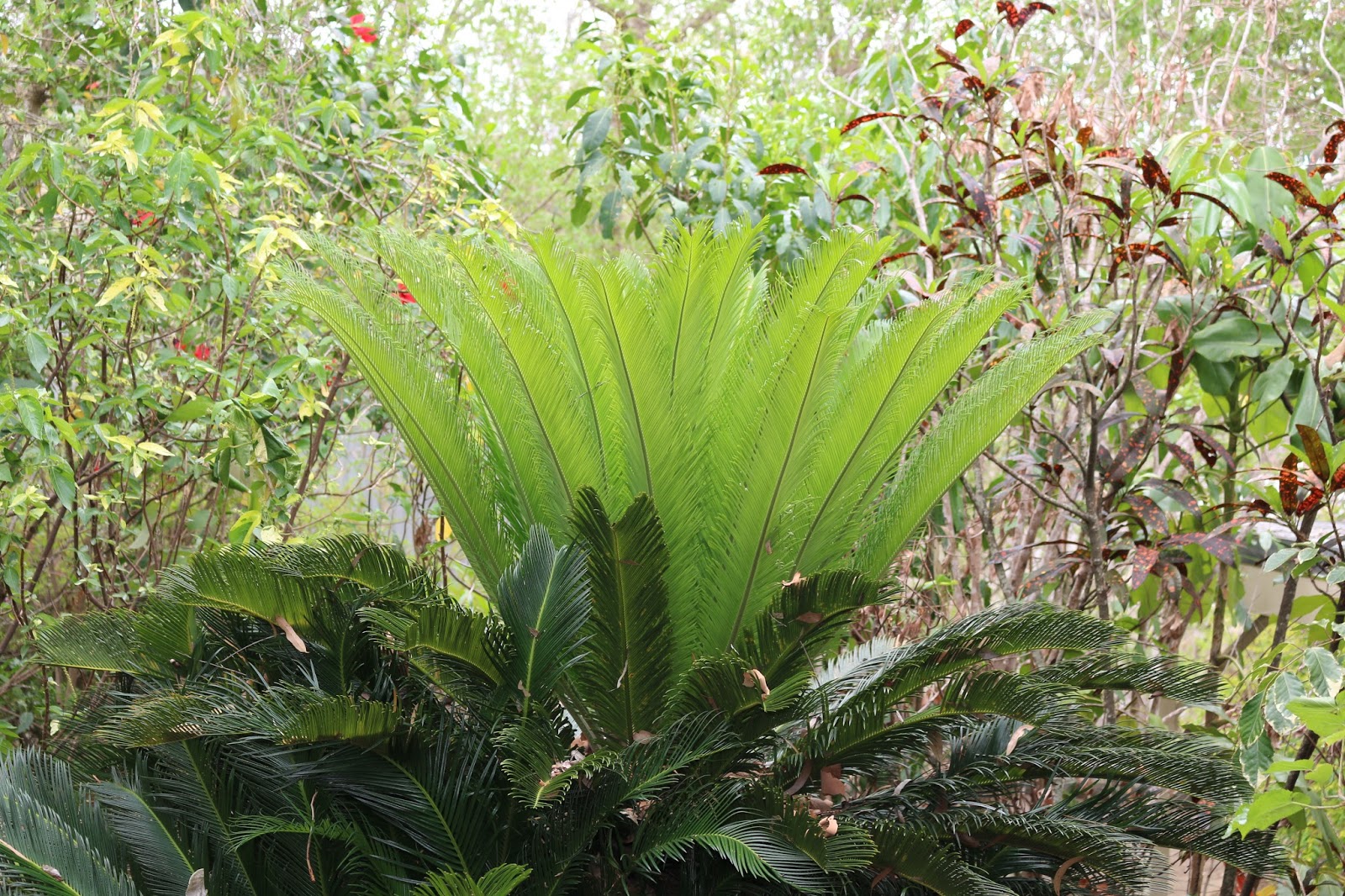
In the courtyard garden,
 |
| Cycas revoluta 'break' |
the other Cycas revoluta has thrown up a new 'break'.
In the new garden bed under the Triangular Palm,
 |
| Scaxodus multiflorus or Blood Lily |
the Scadoxus multiflorus has popped up from its slumber and is beginning to bloom once more,

 |
| Alpinia zerumbet 'Variegata' or Variegated Shell Ginger. |
whilst the Alpinia zerumbet 'Variegata' has begun blooming for the very first time.

 |
| Adenium obesum or Desert Rose |
In the driveway garden bed and the tiered garden bed, there are a couple of Adeniums in bloom,
Garden visitors over the last month have included ...

Blue-banded bees feasting on the nectar of Salvias.

Yellow Honeyeaters feasting on Salvia nectar.


and Sulphur-Crested Cockatoos feasting on the Cadaghi Gum nuts.
Right, I think I really should finish off this post now. That was round-up for the month of November, our last month of Spring. It's now time to get ready for the approaching Summer.


